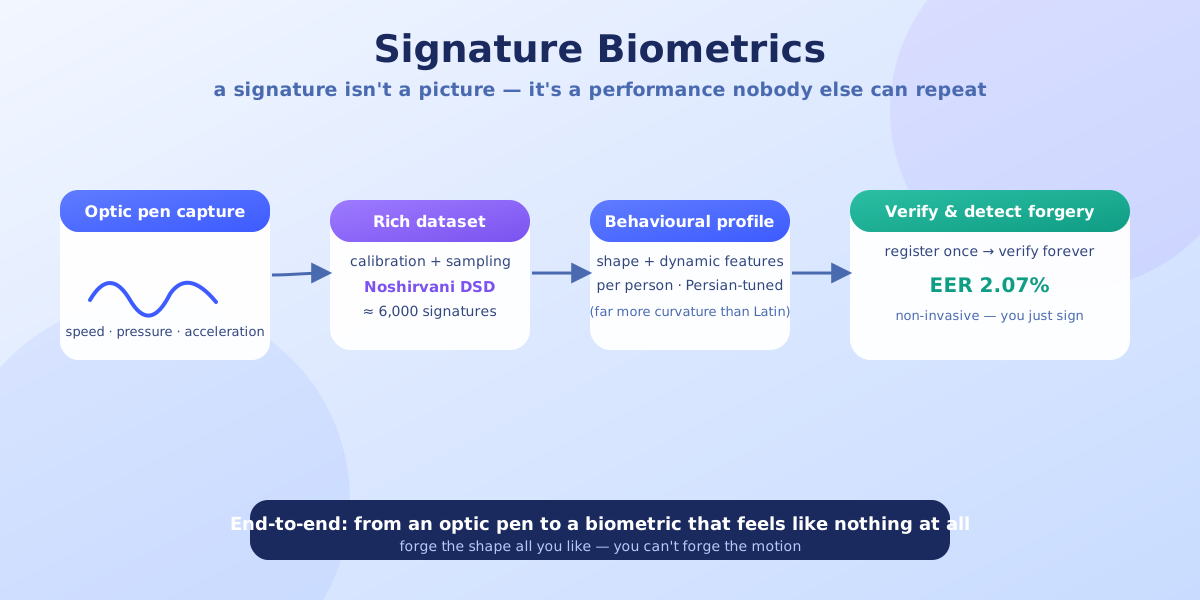
Your signature isn't a picture. It's a performance — the way you sign: how fast the pen moves, how hard you press, where it accelerates and hesitates. Two people can forge the same shape; almost no one can forge the same motion. That performance is a biometric, and this project was built to capture it, learn it, and use it to tell the real you from an impostor.
It's an end-to-end system, and it starts with the hardware. Signatures are captured through an optic pen that records the full dynamics of the act — not just the final mark, but the motion behind it. Turning that raw stream into something a model can learn from took real data-science craft: careful calibration and sampling across different levels of detail, so the captured signal is faithful and consistent. That work produced the Noshirvani Dynamic Signature Dataset — roughly 6,000 signatures rich in both shape and dynamics, which became a benchmark others could build on.
Then comes the hard part: Persian. Persian signatures aren't like Latin ones — they carry far more curvature and end in a distinctive style, with their own signatures of speed, acceleration, and pen pressure. That difficulty is exactly why it was worth doing well. The system builds a profile of each person's signing behavior from shape-based and dynamic features, then uses it for two jobs: verification (are you who you claim to be?) and detection (is this a forgery?).
How it holds up: on the Noshirvani dataset, the approach reached an Equal Error Rate of 2.07% — the kind of number that means a system genuinely works, not just demos well.
The shape of the whole thing: train once, then register real signatures into the system — and from then on, those registered profiles verify and detect future signatures automatically. It's a non-invasive, non-offensive way to confirm identity: no fingerprints, no face scan, no friction — you just sign, the way you always have.
Under the hood (for the engineers): dynamic-biometric acquisition via optic pen, signal calibration and sampling, dataset construction, shape + dynamic feature engineering, and SVM-based classification for verification and forgery detection. Published across several papers — the robust Persian approach (JIST 2015) is open access.
Why it matters (for everyone else): a way to prove you're you that feels like nothing at all — because you're already doing it every time you sign your name.
Skills: Machine Learning · Behavioral Biometrics · Signal Processing · Data Acquisition